
Free, right in your browser
Bass Tuner
This free bass tuner listens to your bass through the microphone, finds the string you played and shows how many cents it is flat or sharp, then tells you to tune up or down. Pick four-string standard (E A D G), drop D, a five-string with its low B or a six-string, or build a tuning of your own. Each string that holds in the green band gets a tick. Plugged in or unplugged, it hears the string. Nothing is recorded or sent.
The low E, 12 cents flat
String 4, the thickest: E1 is 41.20 Hz. A bass string we synthesized, plucked and left to ring.
Bass · Standard
Tune up · 12¢ flat · String 4
Steady after 0.56 s
- no account, nothing recorded
- Free
- plus any you build yourself
- 4 bass tunings
- median error on 437 bass strings
- 0.08¢
- four-string standard, low to high
- E A D G
- a five-string’s low B, read
- B0, 30.87 Hz
- 440 unless you move it
- A4 415 to 466
How do I tune a bass with an online bass tuner?
Open the bass tuner, press Start tuning and allow the microphone. Four-string standard, E A D G from the thickest string, is already set. Pluck the open low E with a finger and let it sustain: the bass tuner names the string and says how many cents flat or sharp it is. Turn a flat string up and a sharp one down until the needle rests in the green band, then do A, D and G and go round once more.
Three steps with the bass tuner online
Use whatever is nearest: a phone, a tablet or a laptop with an up-to-date browser and its built-in microphone, or a microphone you plug in.
Start the bass tuner
Allow the microphone when the browser asks. Four-string standard is chosen; switch to drop D, five-string or six-string if your bass is set up that way.
Pluck one open string
Play it with a finger and let it sustain. The bass tuner works out which string it is; if a string is so far out that it reads as its neighbour, tap it on screen to make it the target.
Bring it into the green
Tune up to the note from below. Once the needle holds in the band for half a second, the string is ticked and the count reads Tuned 1/4, then 2/4.
A bass tuner for four, five and six strings
Built for low notes: this bass guitar tuner reads a five-string’s B through a small microphone, and we played it the same test tones as nine other online tuners.
Standard, drop D, five‑string and six‑string
Four-string standard is E1 A1 D2 G2. Drop D takes the low E down to D1, a five-string adds a low B (B0 E1 A1 D2 G2), and a six-string adds a high C on top (B0 E1 A1 D2 G2 C3). The bass tuner shows the target note of every string, so you always know what you are aiming for.
Reads the low B of a five-string bass
The low B on a five- or six-string bass is 30.87 Hz, low enough that some tuners show nothing at all. This bass tuner reads down to 27.5 Hz, so the B gets a steady reading in cents like any other string. The card here is a clean B0 six cents flat, steady after 0.56 s; through a phone microphone it reads just as true, so give the low B a couple of seconds.
When the microphone misses the fundamental
A phone or laptop microphone hardly picks up 41 Hz, the bottom of a low E. The bass tuner then measures the note from the higher partials, the overtones a small microphone still hears, and checks that the answer isn’t an octave off. In the card, everything under 150 Hz is cut and the low E still reads as E1, 7 cents sharp.
Low notes beside nine other online tuners
Six test tones went into nine online tuners and into ours, two of them bass notes: a four-string’s E1 and a five-string’s B0. Our bass tuner read the E1 at +0.16 to +0.20 cents and the B0 at +0.14 to +0.25 cents. On those two notes, three or four of the others showed nothing or no steady value, and one named the wrong note.
Measured on 437 bass strings
We played the bass tuner every string of every bass preset, tuned true or as far as 25 cents off, with background noise, a faint or absent fundamental and a phone microphone’s low cut: 437 strings in all. The median error was 0.08 cents, 95% of readings came within 0.47 cents, and it never picked the wrong string. It read 433 of the 437; the four left blank had noise only 10 dB below the string.
A steady reading in about half a second
One cycle of a low E lasts 24 milliseconds, so a bass string needs a little longer than a guitar string before its pitch can be pinned down. The bass tuner skips the bright start of the pluck, which runs a little sharp, and on a clean signal gives a steady reading after about 0.56 s. It then holds that reading while the note decays, so the needle stays calm as you turn the tuning key.
Needle or strobe, with the band you choose
The needle shows the cents at a glance inside a green band of ±3 cents; narrow it to ±1 before a recording or open it to ±5 for a quick check between songs. In the strobe view the stripes drift while the string is out and stop when it’s right, which helps with the last fraction of a cent on a long, slow low B.
Reference tones and A4 from 415 to 466 Hz
Every string of the chosen bass tuning has a play button, so you can tune by ear against a clean tone, or check a string with no microphone at all. A4 is 440 Hz unless you move it; set it anywhere from 415 to 466 to match a piano, a band or a record that sits a little high or low.
D standard, or any tuning you build
Make a tuning a semitone at a time, add a lower string or take one off, then copy a link that opens the bass tuner with it set. D standard (D G C F, a whole step down) is a common one; every string you bring into the band is ticked and counted, just as in the presets.
Bass tuner samples: low strings, read by the tuner
Bass strings from our synthesizer, plucked and left to sustain, each read by the tuner’s own code: a flat low E, a five-string B, a low E through a phone microphone, a sharp A, drop D and a G already in tune. Open one to try the studio with its tuning set.
Bass tuner guide: bass guitar tuning, string by string
Standard bass tuning: E A D G
A four-string bass is tuned E1, A1, D2 and G2, from the thickest string to the thinnest: 41.20 Hz, 55.00 Hz, 73.42 Hz and 98.00 Hz. Each string is a fourth above the last, and the four together sound an octave below the four lowest strings of a guitar.
Players count strings from the thin side: the G is string 1 and the low E string 4. On a five-string, the low B is string 5; on a six-string the high C (130.81 Hz) is string 1 and the low B string 6. The bass tuner lists them from low to high, the order you will usually tune them in.
How to tune a bass guitar with a bass tuner
Start on the low E and work towards the G. Finish every string by tuning up to the note: if it is sharp, let it down past the note and bring it back up. The gears in the tuning keys have a little play, and a string tuned upward stays where you leave it.
Heavy bass strings pull hard on the neck, so tuning one moves the others slightly. When all four are ticked, play each again and touch up any that moved.
Play the strings open. The bass tuner compares what it hears with the nearest open string of your tuning, so a harmonic or a fretted note is read against whichever open string it is closest to.
- 1Flat, needle left of the band: tighten the string.
- 2Sharp, needle right of the band: loosen past the note, then come back up.
- 3In the band: the string is ticked; go on to the next.
Five-string, six-string and drop D tuning
A five-string bass keeps E A D G and adds a low B underneath, B0 at 30.87 Hz; a six-string also adds a high C, C3 at 130.81 Hz. Choose the five- or six-string tuning in the bass tuner and the extra strings appear with their own targets, reference tones and ticks.
Drop D lowers only the low E, a whole step down to D1 (36.71 Hz), so riffs in D get an open low note. Turn the string down past D and come back up to it. For D standard (D G C F) or any other drop, build it as your own tuning and keep the link.
Electric bass unplugged, through an amp, or upright
An electric bass can be tuned without plugging in: the microphone hears the string itself. Bring the phone or laptop close to the strings and pluck firmly with a finger. Through an amp, set the microphone near the speaker and switch off drive, chorus and octave effects while you tune.
An upright bass is tuned to the same E A D G as a four-string bass guitar, so the standard preset covers it; hold the microphone near the bridge or an f-hole.
Pluck with the pad of a finger and let the note ring out. A long, even note gives the bass tuner more of those slow low cycles to measure than a short, snapped one.
Low notes, small microphones and the online bass tuner
A plucked bass string sounds its fundamental, 41.20 Hz on the low E, plus partials at two, three and four times that and higher. Phone and laptop microphones hear little below about 150 Hz, so on the lowest strings they catch the partials and almost none of the fundamental.
A tuner that simply follows the strongest frequency can land an octave high there, or on the wrong note. The online bass tuner measures the note from the partials when the fundamental is faint and checks that its answer isn’t an octave off, which is how the phone sample still reads E1.
Setting A4 on the bass tuner: 440 or the band’s pitch
Almost all bass parts sit at A4 = 440 Hz, and the bass tuner starts there. If the band tunes to a keyboard set to 442, or you play along with a recording that runs a little flat, move A4 to match, anywhere from 415 to 466 Hz, and the target of every string follows.
Who reaches for a bass tuner, and when
Six moments a bass needs tuning, each a minute with the bass tuner.
A beginner’s first bass
Learn which string is which while the bass guitar tuner ticks off E, A, D and G one by one.
Five-string bass in a worship band
Tune the low B with the other four before the service. A phone reads it from its partials; give the B a couple of seconds to settle.

Band rehearsal before the set
A string slipped so far it reads as its neighbour? Tap it to make it the target, and set A4 to the keyboard if it isn’t at 440.
Drop D for heavier songs
Take the low E down a whole step to D with the bass tuner for the heavy numbers, then back up to E for the rest of the set.
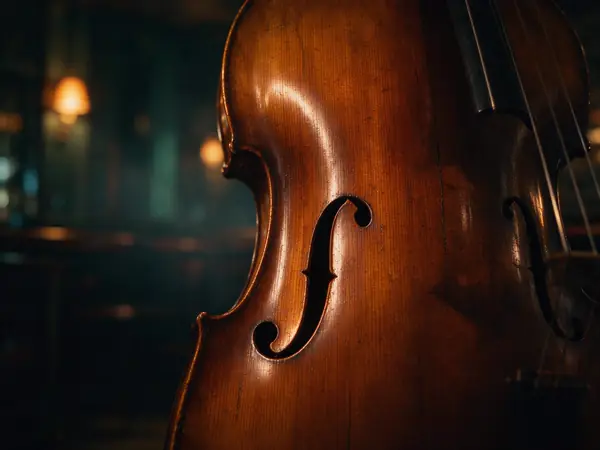
Jazz on an upright bass
An upright shares the E A D G of a bass guitar, so the four-string preset tunes it before the gig.

Quiet practice at night
Headphones in, amp off: the bass tuner hears the unplugged strings through the microphone, so the house stays quiet.
Bass tuner FAQ
More audio tools

Open the bass tuner
Start the bass tuner, pick four, five or six strings and pluck the lowest one: the note, the cents and the way to turn appear at once.