
Free, right in your browser
Mandolin Tuner
This mandolin tuner listens through your microphone, tells you which pair you picked and how many cents sharp or flat it sits, and points the way to turn the peg. Standard G D A E is ready the moment you start. Pick one string of a pair with its partner muted: when it holds in the green band, the pair gets its tick. Tune the partner the same way, and that pair is done. Cross tunings, open G, the mandola and the octave mandolin are one tap away. It is free, there is nothing to sign up for, and what you play stays on your device.
The E string, 9 cents flat
String 1, the highest pair: E5 is 659.26 Hz, the same note as a violin’s E string. One string of a pair we synthesized, its partner muted, picked and left to ring.
Mandolin · Standard
Tune up · 9¢ flat · String 1
Steady after 0.31 s
- no account, nothing recorded
- Free
- mandolin, mandola, octave mandolin
- 8 tunings
- median error, 736 test strings
- 0.05¢
- four pairs, each tuned in unison
- G D A E
- from the pick to a steady reading
- 0.31 s
- for groups at 440, 442 or 432
- A4 415 to 466
How do I tune a mandolin with an online mandolin tuner?
Open the mandolin tuner, press Start tuning and allow the microphone. Standard tuning is set: G D A E, low to high, two strings to each note. Pick one string of the G pair while a finger rests on its partner, and the mandolin tuner shows the note and how far off it is. Bring it up into the green band, then tune the partner the same way. Do the D, A and E pairs, then go round once more.
Tune a mandolin in three steps with the mandolin tuner
A current browser on a phone, tablet or laptop is all the mandolin tuner needs. Set the device near the mandolin in a quiet room.
Press Start tuning
Allow the microphone when the browser asks. G D A E comes up first; pick cross G, cross A, high bass, gee-dad, open G, mandola or octave mandolin if your instrument is set up that way.
Pick one string of a pair
Rest a finger on its partner so only one string sounds. The mandolin tuner works out which pair you picked; tap a pair on screen to keep it as the target, and tap again to go back to auto.
Bring both strings into the green band
Come up to the note from below. When the string holds in the band, its pair gets a tick; tune the partner to the same reading before you move on, and the count climbs to Tuned 4/4.
An online mandolin tuner built for pairs of strings
Eight tunings for the mandolin family in one online mandolin tuner, measured on 736 synthetic mandolin strings picked one at a time, as you tune, and played the same test tones as nine other online tuners.
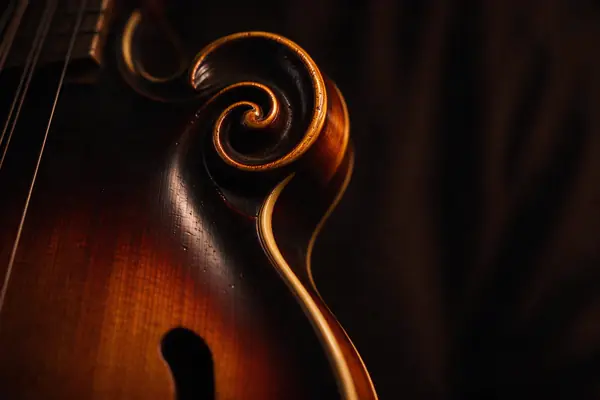
Eight mandolin tunings, from G D A E to the octave mandolin
Standard G D A E, the cross tunings old-time players borrow from the fiddle (cross G, cross A, high bass and gee-dad), open G, and the mandola and octave mandolin. Every tuning lists its four notes, one for each pair, from the lowest pair up, so you know where each pair should land before you pick it.
The same test tones as nine other online tuners
We played six test tones into nine other online tuners and into this one. Most are guitar, bass and ukulele notes, but one is A4 set 12 cents sharp: the exact note of a mandolin’s A pair, 12 cents high. Ours read it at +12.00 cents, and all six within half a cent. On that same A, one of the others named E4 and another gave no reading at all.
Measured on 736 mandolin strings
We synthesized every string of all eight tunings the way you tune them, one string at a time with its partner muted: in tune and up to 25 cents off, with background noise, a weak or missing fundamental and the low cut of a phone microphone, 736 strings in all. The median error was 0.05 cents and 95% of readings came within 0.82 cents, comfortably inside the ±3 cent band. The 6 left without a steady reading all had noise just 10 dB under the string.
A steady reading while the string still rings
A mandolin note is bright at the pick and short, so the reading has to arrive early. The mandolin tuner skips the first sharp instant of the pick and gives a steady reading 0.31 seconds after it, for 95% of strings as well, typically about 2.8 cents above where the string comes to rest. The card shows the G string: steady at 8.7 cents sharp at 0.31 seconds, easing to 6.1.
Needle or strobe, with the band you choose
The needle tells you the cents at a glance, inside a green band of ±3 cents to begin with; narrow it to ±1 for a careful setup or widen it to ±5 between tunes. On the strobe, stripes run right while a pair is sharp and left while it is flat, slow down as you close in, and stop once it is there.
Hear each pair’s note and tune by ear
Every pair in the mandolin tuner has a button that plays its target note, so you can match a string by ear, the way many players check a pair anyway. Set A4 anywhere from 415 to 466 Hz, with 442 and 432 one tap away, to sit with a fiddle, an accordion or a recording that is not at 440.
Your own mandolin tuning, kept in a link
Raise or lower any pair a semitone at a time to build a mandolin tuning the list leaves out, such as calico, or open A (A E A C♯), an old-time fiddle tuning that suits the mandolin too. Copy the link and the mandolin tuner opens with your tuning in place; the ticks and the Tuned count work just as they do for the eight presets.
Mandolin tuner samples: single strings and their readings
Six mandolin strings we synthesized, each picked on its own with its partner muted: the standard E, G and A, the G pair raised for cross A, a mandola’s C and an octave mandolin’s G, each read by the code the mandolin tuner runs in the studio. Open a card to try it, and the studio switches to that card’s tuning.
Mandolin tuning guide: G D A E, cross tunings and the family
Standard mandolin tuning: G D A E in four pairs
A mandolin has eight strings in four pairs, called courses, and the two strings of each pair are tuned to the same note. Standard mandolin tuning runs G3, D4, A4 and E5 from the lowest pair to the highest: 196.00 Hz, 293.66 Hz, 440.00 Hz and 659.26 Hz, each pair a fifth above the last. Those are the open strings of a violin, so fiddle tunes and fiddle tunings carry straight over.
Players count pairs from the floor up, so the E pair is string 1, A string 2, D string 3 and the G pair string 4. The mandolin tuner shows one button per pair, G first; a pair gets its tick as soon as the string you pick holds in the band, so tune its partner too before you move on.
How to tune a mandolin with the mandolin tuner
Tune one string at a time. Rest a finger of your picking hand lightly on the partner so it stays quiet, pick the other, and bring it to the note; then swap. Finish every string by coming up to the note: if it is sharp, let it down past the note and turn back up, so the peg holds the string firmly.
Start with the G pair and work up to E. On most mandolins the bridge is held in place by the strings rather than glued, so a big change on one pair moves the others a little; when all four are ticked, go round again. Then pick both strings of each pair together and listen: a slow wobble means the two still differ, and a touch on one peg makes it stop.
- 1Flat, needle to the left: turn the peg up.
- 2Sharp, needle to the right: go below the note, then up to it.
- 3Ticked and in the band: tune the partner, then the next pair.
Cross tunings: G D G D, A E A E, A D A E, G D A D and open G
Cross tunings retune some pairs so the open strings ring with the key of the tune. Cross G, also called sawmill (G D G D), takes the A pair down a whole step to G4 and the E pair down to D5. Cross A (A E A E) raises the G pair a whole step to A3 and the D pair to E4. High bass (A D A E) raises only the G pair to A, a common choice for tunes in D and A. Gee-dad (G D A D) lowers just the E pair to D5.
Open G (G D G B) brings the A pair down to G4 and the E pair down to B4, so the open strings ring a G major chord. Raising pairs adds tension, so some players tune cross G and put a capo at the second fret instead: the open strings then sound A E A E.
Mandola and octave mandolin tuning
The mandola is the mandolin’s bigger sister, tuned C3 G3 D4 A4, a fifth lower, the same notes as a viola. In Ireland and the UK it is often called the tenor mandola. Its low C pair sits at 130.81 Hz.
The octave mandolin, called the octave mandola in much of Europe, is tuned G2 D3 A3 E4, a full octave under the mandolin, so the fingering stays the same. Choose Mandola or Octave mandolin in the mandolin tuner and every pair’s target moves with it; the low G of an octave mandolin reads at 98.00 Hz.
Mandolin tuning chart: all eight tunings
Every tuning in the mandolin tuner, one note per pair, from string 4 up to string 1:
- 1Standard: G3 D4 A4 E5
- 2Cross G or sawmill: G3 D4 G4 D5
- 3Cross A: A3 E4 A4 E5
- 4High bass: A3 D4 A4 E5
- 5Gee-dad: G3 D4 A4 D5
- 6Open G: G3 D4 G4 B4
- 7Mandola: C3 G3 D4 A4
- 8Octave mandolin: G2 D3 A3 E4
Pairs that wobble, quick notes and A4 on the mandolin tuner
Pick each string on its own for the clearest reading. When both strings of a pair ring and differ slightly, the sound swells and fades slowly and the reading moves with it; once each string sits in the band, the pair rings as one note. A mandolin note fades quickly, so pick firmly near the microphone and pick again rather than waiting.
The mandolin tuner starts at A4 = 440 Hz. With a fiddler, a mandolin orchestra or a recording pitched a little high or low, set A4 anywhere between 415 and 466 Hz, and every pair’s target follows.
New mandolin strings stretch and drift flat for a few days. Run the mandolin tuner each time you pick up the instrument until they hold.
When a mandolin tuner comes in handy
From the first lesson to the mandolin orchestra, six moments the mandolin tuner is worth opening.

A first mandolin
Learn which pair is which, G at the top to E at the bottom, as each pair earns its tick.

A bluegrass jam
G D A E checked pair by pair before the first break, so the mandolin sits with the banjo and fiddle.
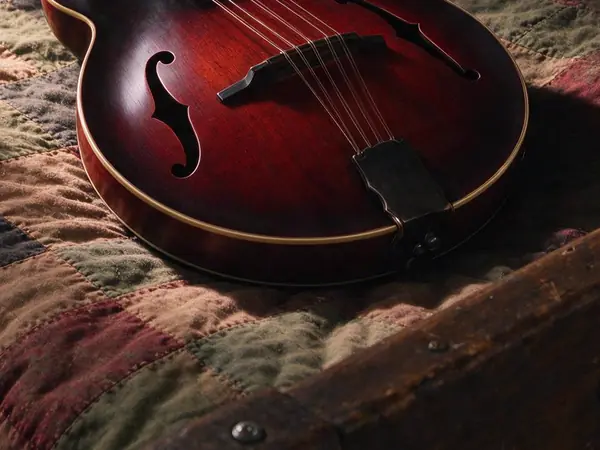
Old-time tunes in cross A
Raise the G and D pairs a whole step for A E A E, then come back to standard for the next set.

Irish tunes at a session
Standard tuning matches the fiddles note for note; move A4 if the session sits away from 440.

A mandolin orchestra rehearsal
Mandolins in G D A E and mandolas in C G D A, with everyone on the same A4.
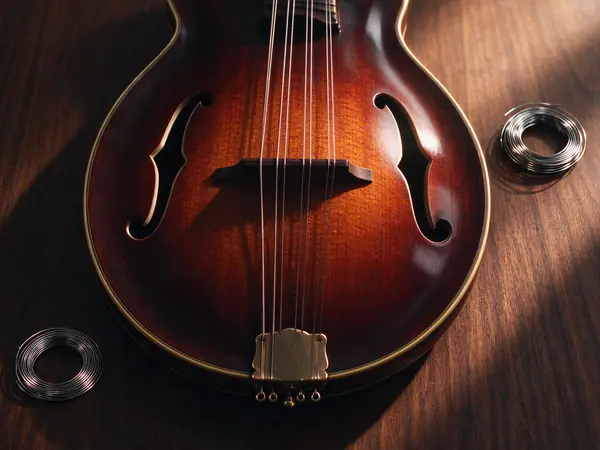
Right after new strings
Fresh strings stretch; check each pair after every tune until all four stay in the band.
Mandolin tuner FAQ
More audio tools



Open the mandolin tuner
Start the mandolin tuner, pick the G pair one string at a time and work up to E: each pair shows its note, its cents and which way to turn.