
Free, no account needed
Viola Tuner
This viola tuner hears an open string through your microphone, names it as the C, G, D or A, and shows in cents how far it sits below or above the note, then prompts you to tune it up or down. Standard viola tuning, C3 G3 D4 A4, is ready the moment you start. Raise A4 to 442 when the orchestra pitches high, drop it to 415 for period pitch, or design your own tuning. A string that stays inside the green band gets a tick. Nothing is recorded or uploaded.
The A string, 6 cents flat
String 1, the highest, the note an orchestra tunes to: A4 is 440.00 Hz. A viola string we synthesized, bowed steadily.
Viola · Standard
Tune up · 6¢ flat · String 1
Steady after 0.41 s
- no sign-in, nothing uploaded
- Free
- lowest string to highest
- C G D A
- 95% of readings, synthetic bowed notes
- ±0.15¢
- the string a violin lacks, read as C3
- Low C
- green band of ±1, 3 or 5¢
- Needle, strobe
- orchestra 442, baroque 415
- A4 415 to 466
How do you tune a viola with an online viola tuner?
Open the viola tuner and press Start tuning, then allow microphone access; the standard C G D A is preselected. Begin on the A. Draw a slow, even bow across it, or pluck it, and the viola tuner tells you which string it heard and how many cents away it is. Use the fine tuner for a small gap and the peg when the gap is large, until the needle comes to rest in the green band and a tick appears. Then the D, the G, and last the low C, before one more check of the A.
The online viola tuner in three steps
Nothing to install: the online viola tuner works in a current browser on a phone, tablet or laptop. Put the device on your stand or a chair, close enough to catch the viola’s sound.
Start the tuner
Tap Start tuning, then grant microphone access. The viola tuner lists the four strings; if your group tunes to 442, change A4 before you play.
Sound one open string
Bow or pluck a single open string. The viola tuner works out which of the four it is, or you can tap a string yourself to lock the target.
Bring it into the band
Turn gently until the needle comes to rest inside the green. That string earns its tick and the counter reads Tuned 1/4.
Inside the viola tuner: strings, accuracy and views
Four strings stacked in fifths, read by the viola tuner from a long bow stroke or a pluck, with every figure taken from tests we ran ourselves.
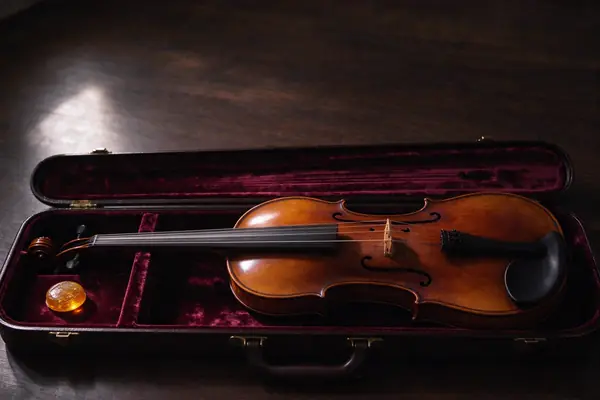
Viola tuning: C G D A
Standard viola tuning runs C3, G3, D4 and A4 from the bottom up, and each string sits a perfect fifth over the one beneath it. Next to every reading the viola tuner puts two frequencies side by side: the one it hears and the one that string should reach. Strings are recognised from the note, so tune them in whatever order suits you. If one is so low or high that it passes for the string next door, tap the string you mean and the tuner holds it as the target.
Tested on synthetic bowed viola notes
To test the viola tuner we generated 92 bowed viola notes that hold perfectly steady: every string, in tune or as much as 25 cents off, some under background noise, some with a weak or absent fundamental, some trimmed at the low end the way a phone microphone trims it. The median error is 0 cents to two decimal places, 95% of readings landed within 0.15 cents, and not one note was put on the wrong string. These synthetic notes gave a steady reading after 0.41 s. A real bow stroke wavers more as it starts, so keep one long, even stroke going for one or two seconds.
Six test tones, nine other online tuners
Our comparison sent one set of six test tones to nine other online tuners and to this one. None of them is a viola note: they come from guitar, bass and ukulele. One, though, is A4, the pitch of the viola’s A string, set 12 cents sharp, and we read it at +12.00 cents. Across the six, our readings were never more than half a cent out; some of the others found nothing on the lowest notes or gave the wrong note name.
A weak fundamental on the low C
A viola’s body is small for its low C, so that string’s fundamental comes out weakly. In a sample where it sits 15 dB below its partials, the viola tuner still reads C3, 4 cents flat: it works the pitch out from the partials and makes sure the reading has not landed on the octave above.
Needle for speed, strobe for the last cent
In the viola tuner, the needle gives the distance at a glance against a green band, ±3 cents unless you change it: ±1 when a quartet rehearsal needs it exact, ±5 when a quick pass will do. The strobe view suits the final touch. Its stripes slide while the pitch is off, slow down as you approach and freeze once the string is true.
Hear each string’s note, then tune by ear
Tap any string in the viola tuner and it sounds that note. Match each string to its own tone by ear, one string at a time, with the microphone switched off. A4 can sit anywhere between 415 and 466 Hz: 442 or 443 where an orchestra pitches high, 415 for period instrument groups, and every string’s tone moves with it.
A five-string viola tuning, saved as a link
A five-string viola adds a high E above the A, C G D A E, and some fiddle and jazz players use one. Build that or any other tuning string by string in semitone steps, adding or removing strings as you need, then share it as a link: the one shown here opens the viola tuner set to C G D A E. Every string that stays in the band is ticked, so Tuned 3/5 means three of the five are done.
Viola tuner samples: open strings and their readings
Synthetic viola strings under a steady bow, each read by the viola tuner’s own code: an A 6 cents flat, a C 7 cents sharp, a D 10 cents flat, a G already in tune, a low C with a weak fundamental, plus a freshly fitted A string 20 cents flat. Open any card to keep going in the studio, set to the viola.
Viola tuning guide: the low C, pegs and pitch
The notes of the viola strings
Counting up from the lowest, the viola’s strings are C3, G3, D4 and A4. With A at 440 Hz they vibrate at 130.81, 196.00, 293.66 and 440.00 Hz, and neighbouring strings lie a perfect fifth apart.
The viola sits a fifth below the violin and shares three of its strings, the G, the D and the A. The low C is the one a violin doesn’t have, and much of the viola’s darker voice comes from it. Players count from the top: the A is string 1, the D string 2, the G string 3 and the C string 4, and the viola tuner names strings the same way.
Violists read mostly in alto clef, whose middle line is middle C (C4), one octave above the open C string.
How to tune a viola, from the A down
Take the A first, because ensembles tune to it, then work downward through the D, the G and finally the C. A slow bow with steady weight reads best; or rest the viola upright on your lap and pluck while your other hand works the peg.
Let only one string ring, with the bow clear of its neighbours, since a lone clean note reads most steadily. When all four strings carry a tick in the viola tuner, go back to the A: bringing up the lower strings changes the tension across the bridge and can pull the A slightly.
- 1Needle left of centre means flat: tighten the fine tuner, clockwise, to raise it.
- 2Needle right of centre means sharp: loosen it, anticlockwise, to lower it.
- 3Needle in the green: that string is done, so move on.
Fine tuners and pegs on a viola
On the tailpiece sit the fine tuners, small screws for the final few cents the viola tuner shows. Many violas carry one on the A string only, while student instruments often have one on every string.
Use the peg for a string that is well out, or a new one being brought up to pitch. Move it in short turns while pressing it inward, which helps it seat and stay put.
When a fine tuner is screwed almost all the way down, back it out to mid travel and make up the pitch at the peg; next time you will have room to go either way.
Setting the viola tuner to your group’s pitch
A4 = 440 Hz is the common reference. Many orchestras pitch a touch above it, at 442 or 443, and period ensembles commonly use 415, almost a semitone down. Change A4 in the viola tuner at home, the four targets shift with it, and you arrive in step with the section.
Pure fifths by ear, and where the C ends up
Many violists tune the A, then sound two adjacent strings at once and adjust until the fifth stops beating. A fifth with no beats is wider than an equal tempered one by close to 2 cents, and the equal tempered fifth is what the viola tuner aims for. On the way down those small gaps add up: tuned from the A by ear, the D ends up near 2 cents flat, the G near 4 and the C near 6.
That last figure lies outside even the ±5 band, and a C that low can sound flat against a piano. To keep the C closer to the piano, tune it straight to the viola tuner, or narrow each fifth a little as you go.
New strings and the viola tuner
A newly fitted string keeps stretching for several days, so it drifts flat between sessions. Bring it up at the peg, play for a few minutes and check it again; the viola tuner shows how far it fell, like the new A on this page, which read 20 cents flat.
As the strings come up to tension they drag the bridge’s top edge toward the fingerboard. Check it side-on every so often and keep it upright.
Who reaches for a viola tuner
A minute with the viola tuner before you play, at home, in a lesson or at rehearsal.

A violinist taking up the viola
The G, D and A feel familiar, but the C is new: the viola tuner names each string, so you always know which one you are hearing.

A student’s first months
A teacher or parent taps the A, brings its fine tuner into the band, then goes down through D, G and C with a tick for each.
Orchestra night at A 442
Change A4 to 442 before you pack the case, and your four strings arrive already at the orchestra’s pitch.
A string quartet warming up
Everyone checks their open strings against the same A, and the violist uses the viola tuner to make sure the C has not sunk too low.
A viola back out of its case
Slack strings come up at the pegs, the fine tuner finishes the A, and the viola tuner ends on Tuned 4/4.
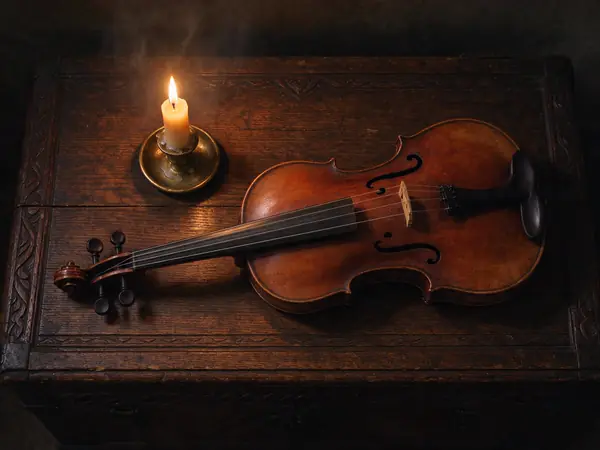
A baroque concert at 415
Set A4 to 415 for an ensemble at period pitch, and every string’s target moves down with it.
Viola tuner FAQ
More audio tools
Start the viola tuner
Bow the open A into the viola tuner and see how many cents it is off and whether to tune it up or down.