Can You Copyright AI Music? What the Law Says in 2026
Can you copyright AI music? Mostly only the human parts. The rules in the US, UK, EU and China as of October 2026, and what to check before you sell.
Audio AI Studio10 min read
On this page
- The short answer, country by country
- United States: only the human parts are protected
- United Kingdom: a special rule that may go
- European Union: human originality, plus labels
- China: one court looked at the user's choices
- Can you sell AI generated music?
- Which situation are you in?
- FAQ
- Make a song with your own lyrics
Can you copyright AI music? Only in part. In the United States, a track generated from a text prompt alone is not protected, because copyright covers only what a human author created. What you add yourself can be protected: lyrics you wrote, music you composed, and the creative way you arrange or edit the output. Other countries draw the line in different places, and as of October 2026 the rules are still moving.
Two events in 2026 shaped the answer. On 2 March 2026 the U.S. Supreme Court declined to hear the leading case on AI authorship, which leaves the human authorship rule in place. On 18 March 2026 the UK government proposed removing the special protection British law gives to works made by a computer with no human author.
This guide covers the rules in the US, the UK, the EU and China, then the question most people are really asking: can you sell AI generated music? It is general information checked on 29 October 2026, not legal advice; for a release with money at stake, ask a lawyer where you live.
The short answer, country by country
| Where | Music generated by AI alone | What can be protected | Main source |
|---|---|---|---|
| United States | Not protected | Lyrics, music and arrangements a person wrote; creative selection, arrangement or editing of the output | Copyright Office report, January 2025; Thaler v. Perlmutter, 2025 |
| United Kingdom | Protected for now as a "computer generated work", for 50 years | Human works as usual; the government proposes ending the special rule | CDPA 1988, section 9(3); government report, 18 March 2026 |
| European Union | No special rule; protection needs the author's own intellectual creation | The human author's creative choices | Court of Justice, Infopaq, 2009; AI Act, Article 50 |
| China | Decided case by case | The user's original intellectual input, as one court found for an AI image | Beijing Internet Court, 27 November 2023 |
United States: only the human parts are protected
The U.S. Copyright Office set out its position in Copyright and Artificial Intelligence, Part 2: Copyrightability (January 2025). Its main conclusions, quoted from the report:
- "Copyright does not extend to purely AI-generated material, or material where there is insufficient human control over the expressive elements."
- "The use of AI tools to assist rather than stand in for human creativity does not affect the availability of copyright protection for the output."
- "Based on the functioning of current generally available technology, prompts do not alone provide sufficient control."
- "Human authors are entitled to copyright in their works of authorship that are perceptible in AI-generated outputs, as well as the creative selection, coordination, or arrangement of material in the outputs, or creative modifications of the outputs."
The report explains the prompt point in plain terms: prompts "essentially function as instructions that convey unprotectible ideas", and even a detailed prompt does not control how the system turns it into music. It also recommends no change to the law: the Office found that "the case has not been made for additional copyright or sui generis protection for AI-generated content."
The courts agree. In Thaler v. Perlmutter, decided on 18 March 2025, the Court of Appeals for the D.C. Circuit held that "the Copyright Act of 1976 requires all eligible work to be authored in the first instance by a human being."
The same opinion stresses that the rule "does not prohibit copyrighting work that was made by or with the assistance of artificial intelligence." Dr. Thaler asked the Supreme Court to review the case (docket 25-449), and the petition was denied on 2 March 2026.
What this means for a song made with AI:
- Lyrics you wrote are your work, whether a human or an AI sings them. Your text is protected as text.
- Music you composed or played and then used in the track stays yours, to the extent it can be heard in the result.
- A track from a prompt alone has no human author in the Office's view, so nobody can claim copyright in it.
- Your creative edits and arrangement can be protected: cutting sections together, combining AI parts with your own recordings, rewriting parts. The Office decides how much is enough case by case.
If you register a work that contains more than a small amount of AI generated material, the Copyright Office asks you to say so and to describe the human contribution. Keep your drafts, lyrics, prompts and edit history: they show what you did.
United Kingdom: a special rule that may go
British law has an unusual provision. Section 9(3) of the Copyright, Designs and Patents Act 1988 says: "In the case of a literary, dramatic, musical or artistic work which is computer-generated, the author shall be taken to be the person by whom the arrangements necessary for the creation of the work are undertaken."
According to the government, this protection lasts for 50 years, and for a general purpose AI that answers prompts, "the author" will usually be the person who typed the prompt.
That may change. In its Report on Copyright and Artificial Intelligence, published on 18 March 2026, the government wrote that "in the absence of evidence of its ongoing value, we propose that it should be removed", while "copyright should continue to protect works created with AI assistance."
Describing that option, the report notes that AI generated music "could continue to be protected as sound recordings." It is a proposal, not a new law: the report says reforms will not be introduced until the government is confident they will meet its objectives.
European Union: human originality, plus labels
The EU has no special rule for works without a human author. Under the case law of the Court of Justice, copyright applies only to subject matter that is original "in the sense that it is its author's own intellectual creation" (Infopaq, C-5/08, 16 July 2009, paragraph 37). The UK government's 2026 report reads this as meaning that wholly AI generated outputs are unlikely to be protected in the EU.
The newer EU rule is about labels, not ownership. Article 50 of the AI Act requires providers of AI systems that generate synthetic audio, images, video or text to mark the output "in a machine-readable format and detectable as artificially generated or manipulated."
Businesses and other professional users that publish a deep fake, such as audio that imitates a real person, must disclose that it was generated or manipulated. Under Article 113, the AI Act applies from 2 August 2026, and Article 50 is not among the exceptions with other dates.
China: one court looked at the user's choices
A 2023 judgment shows how a Chinese court approaches the question. In its judgment of 27 November 2023 (case (2023) 京0491民初11279号), the Beijing Internet Court found that a picture made with an AI image model was a work, and that the user who made it was its author.
The court pointed to the user's intellectual input: designing how the figure is presented, choosing the prompts and their order, setting the parameters, and picking the image that matched the plan. It awarded 500 yuan in damages and an apology for the copied picture.
The same judgment says the model itself cannot be an author, that its designer is not the author either, and that whether AI generated content is a work must be judged case by case. The case concerned an image, not a song.
China also requires labels. The Measures for Labeling AI-Generated Synthetic Content (国信办通字〔2025〕2号), in force since 1 September 2025, cover audio as well as text, images and video. For audio, an explicit label can be a spoken notice or a rhythm cue at the start, end or middle, or a clear notice in the interface. Users who publish AI generated content must declare it and use the platform's labelling function (Article 10).
Can you sell AI generated music?
Copyright and permission to use are two different questions. Even where nobody owns the copyright in an AI track, you can often still release it, but four things decide whether you can do so safely.
- The service's terms. What you may do with the output is set by the terms of the tool you used. Read them before you release anything. Look for what they say about who owns the output, commercial use and credit.
- Other people's rights. A track that copies a real song, or imitates a real singer, can break the law no matter who made it. Spotify, for example, states that "vocal impersonation is only allowed in music on Spotify when the impersonated artist has authorized the usage" (announced 25 September 2025).
- Labels and disclosure. The EU and China now require AI content to be marked, and platforms ask for it too. Spotify supports an industry standard for AI credits and says the change is "not about punishing artists who use AI responsibly."
- What you cannot stop. If a track has no human author, you have no copyright to enforce, so others may be free to reuse it. The more of the song is your own work, the more you can protect.
A practical rule: if you want to own a song, put yourself in it. Write the lyrics, shape the arrangement, edit the result, and keep a record of what you did.
Which situation are you in?
| What you made | Likely position in the US |
|---|---|
| An instrumental from a one line description | No copyright in the music |
| A song with lyrics the AI wrote for you, unedited | No copyright in the lyrics or the music |
| A song with lyrics you wrote yourself | Your lyrics are protected; the generated music is not |
| AI parts edited, cut and combined with your own recordings | Your creative selection, arrangement and edits can be protected |
| Your own composition, with AI used only as a tool | Protected as your work |
FAQ
Can you copyright AI music?
In the US, only the parts a human created: your lyrics, your music, and your creative selection, arrangement or editing of the output. Music generated from a prompt alone is not protected. The UK still protects computer generated works for now, and China decides case by case.
Is AI generated music copyrighted?
Not automatically. Purely AI generated music has no copyright in the US and, by the UK government's reading, probably none in the EU. Parts written by a person keep their protection.
Can I sell AI generated music?
Usually yes, if the terms of the service you used allow it, the track does not copy someone else's song or voice, and you follow the labelling rules where you publish. Without copyright, though, you may not be able to stop others from copying a purely AI track.
Is AI music legal?
The rules covered here do not ban making music with AI; they decide who owns it and how it must be labelled. What can make a particular track unlawful is its content, such as copying a protected song or imitating a real singer without permission, or publishing it without a required AI label.
Do I have to say a song was made with AI?
In the EU and China, rules now require AI generated content to be marked, and Spotify accepts AI credits for tracks. When you register a work in the US that contains more than a small amount of AI material, the Copyright Office asks you to disclose it.
Can I copyright the lyrics if AI made the music?
Yes, lyrics you wrote are your own text. The copyright covers your words, not the generated melody or recording.
Make a song with your own lyrics
The surest way to own more of an AI song is to bring your own words. Here is how with our tools:
- Open the AI song generator and paste your lyrics, up to 3,000 characters. Mark the parts with [Verse], [Chorus] and [Bridge].
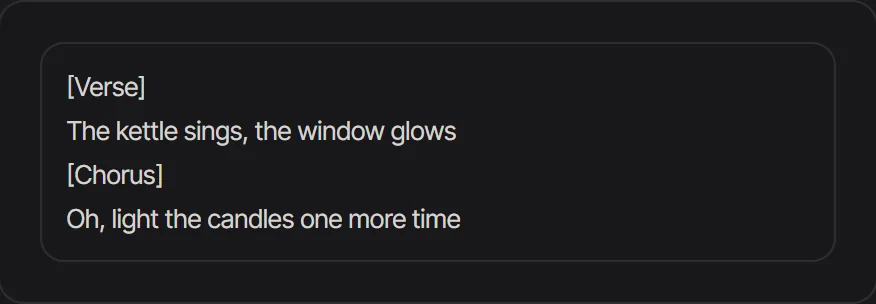 Your own lyrics in the AI song generator, marked by verse and chorus
- Describe the style, for example "acoustic folk, warm and slow", and pick a female, male or automatic voice.
- Sign in and generate. A song costs 60 credits, shown on the button before you start.
- Download the MP3 and the lyrics as a text file. Keep your drafts and notes with them.
For background music without vocals, the AI music generator turns a short description into a full track. Remember what the US Copyright Office says about prompts: a description alone does not make you the author of the music, so plan to edit, arrange or combine the result if ownership matters to you.
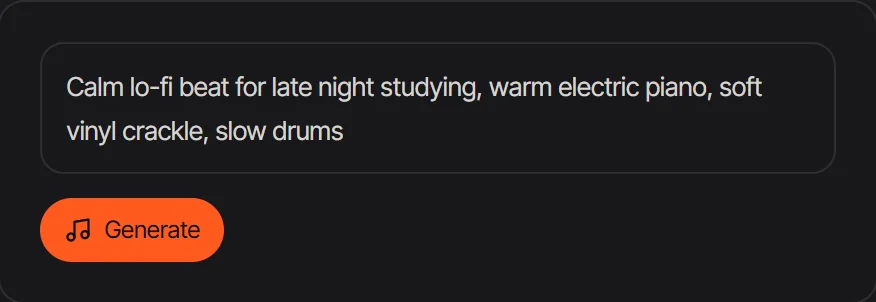 A short description of the music in the AI music generator
Your songs are private: only you can hear them until you share them, and they stay in your library for 30 days.