
How to Find the Key of a Song: 4 Ways That Work
How to find the key of a song by ear, from its chords, from sheet music or with a key finder, and the three near misses that trip up people and software.
Audio AI Studio9 min read

On this page
The quickest answer to how to find the key of a song: listen for the note the music feels at home on, then decide whether the scale around it sounds major or minor. That home note plus its mode is the key. You can do it by ear, read it from the chords or the sheet music, or let a key finder do the listening in a few seconds.
Software is not as sure as it looks. We ran our own key finder on 1,441 songs from two public research sets: its first answer was exactly right for about 60% of them, and the right key was one of its two answers for 76% to 80%. Most misses were not random. They landed on a related key, and the same three near misses catch people too. This guide covers four ways to tell what key a song is in, and how to avoid those traps.
The short answer
| Method | What you need | Time | Best for |
|---|---|---|---|
| By ear | The song and an instrument or tuner app | 2 to 5 minutes | Singers, players learning a song |
| From the chords | A chord sheet, or chords you can hear | 1 minute | Guitarists and songwriters |
| From sheet music | The score | Seconds | Classical and choir parts |
| With a key finder | The audio file | Seconds per song | DJs, producers, whole folders |
Every method ends with the same check: play or hum the home chord against the song. If it sounds like an ending, you have the key.
What the key of a song is
A key has two parts. The tonic is the note the song keeps returning to, the one that sounds like home. The mode is the scale built on it, major or minor. Twelve notes times two modes gives 24 keys, from C major to B minor.
The difference between major and minor sits in the third note of the scale. In a major key it is four semitones above the tonic and the music tends to sound bright; in a minor key it is three semitones up and the music tends to sound darker.
One fact explains most mistakes: every major key shares all seven of its notes with one minor key, its relative minor. C major and A minor use exactly the same notes, the white keys of a piano. So knowing which notes a song uses narrows it down to two keys. Deciding which of the two is home is the real work.
Method 1: Find the key by ear
You need no theory for this, just a way to name a note: any instrument, or a free tuner app on your phone that shows the note you sing.
- Play the song to the end of a chorus or the very end of the track. Endings almost always land on the tonic.
- Hum the note that feels most at rest. Hold it while the song plays; if it fits under every bar of the chorus, you have it.
- Name that note on your instrument or tuner. That is the tonic.
- Sing up three steps of a scale from it. If the third note sounds happy, the key is probably major; if it sounds sad or tense, minor.
- Check by humming the whole scale over the song. Notes that clash tell you the mode is wrong.
Tip: listen to the bass. In most pop, rock and dance songs the bass plays the tonic at the end of each section, and it is easier to pick out than the vocal.
Method 2: Read the key from the chords
If you have a chord sheet, or can hear the chords, the key is usually in plain sight.
- The last chord of the song is the tonic chord in most popular music, and the first chord often is too.
- The set of chords narrows it to a relative pair. A song built on C, F, G and Am is in C major or A minor; one built on G, C, D and Em is in G major or E minor.
- The home chord decides between the two. If the chorus resolves to Am, it is A minor; if it resolves to C, C major.
- A major V chord in a minor song is a giveaway. Songs in A minor often use E major instead of E minor, and that raised note (G♯) is not in C major at all.
| Chords you hear | Candidate keys | What decides it |
|---|---|---|
| C, F, G, Am | C major or A minor | Which chord ends the chorus |
| G, C, D, Em | G major or E minor | Same check |
| Am, Dm, E | A minor | The E major chord |
| D, G, A, Bm | D major or B minor | Which chord feels like rest |
Method 3: Read the key signature
Sheet music shows the key signature at the start of every line: a set of sharps or flats. It gives you the relative pair at a glance, with its codes on the Camelot wheel that DJs use.
| Signature | Major key | Minor key | Camelot |
|---|---|---|---|
| No sharps or flats | C major | A minor | 8B / 8A |
| 1 sharp | G major | E minor | 9B / 9A |
| 2 sharps | D major | B minor | 10B / 10A |
| 3 sharps | A major | F♯ minor | 11B / 11A |
| 4 sharps | E major | C♯ minor | 12B / 12A |
| 1 flat | F major | D minor | 7B / 7A |
| 2 flats | B♭ major | G minor | 6B / 6A |
| 3 flats | E♭ major | C minor | 5B / 5A |
| 4 flats | A♭ major | F minor | 4B / 4A |
Then look at the last bass note, or the last chord: it tells you whether the piece is in the major or the minor key of the pair.
Method 4: Use a key finder
A key finder measures how strongly each of the twelve notes sounds across the whole song, then compares that mix with the pattern each of the 24 keys tends to leave and names the best match. It also gives a second candidate, because the runner up is often the relative key.
Here is how ours did on two public research sets, which we use only to measure accuracy:
| Test set | Songs | First answer exactly right | Right key among the two answers |
|---|---|---|---|
| GiantSteps Key (electronic dance music) | 604 | 59.8% | 75.8% |
| GTZAN (blues, country, pop, rock and more) | 837 | 60.8% | 79.6% |
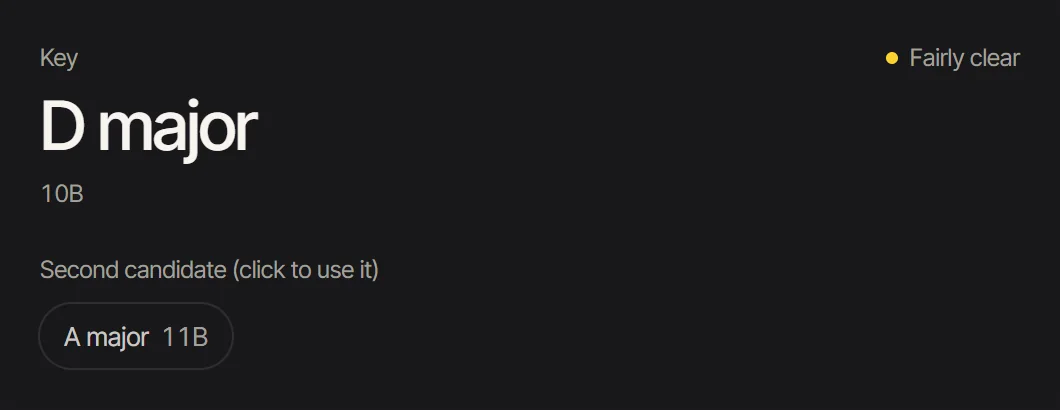 A reading of D major (10B), marked fairly clear, with A major (11B) offered as the second candidate.
The finder also says how sure it is. On the GiantSteps set, the 37% of songs it marked clear were exactly right 74.3% of the time; on GTZAN, the 29% marked clear were right 85.9% of the time. A reading marked "check by ear" deserves exactly that.
The three near misses
We sorted every first answer from those runs by how it missed:
| First answer | GiantSteps (604 songs) | GTZAN (837 songs) |
|---|---|---|
| Exactly right | 59.8% | 60.8% |
| The key a fifth above | 7.3% | 8.0% |
| The relative key | 7.8% | 4.1% |
| Same tonic, other mode | 8.6% | 11.8% |
| Another key, or no key found | 16.6% | 15.3% |
In both sets about 24% of answers were one of the three near misses below. They are worth knowing whichever method you use.
The relative key
A minor and C major share every note, so only the sense of home separates them. Songs that sit on the relative chord for long stretches, or end on it, fool listeners and software alike. Check with the chord test: play both tonic chords against the song and keep the one that sounds like an ending.
The key a fifth away
Keys a fifth apart, such as C major and G major, share six of their seven notes. A song that leans hard on its fifth chord can sound like it is in that chord's key. The one note that differs (F in C major, F♯ in G major) settles it: hum both against the melody and listen for the clash.
Same tonic, other mode
A minor and A major share their home note but not their third. Blues, rock and soul often mix major and minor thirds on purpose, which is why this was the largest miss on GTZAN. In that set's labels, 97% of the blues clips and 96% of the metal clips are in minor keys, against 5% of the country clips. When in doubt, sing the third over the chorus.
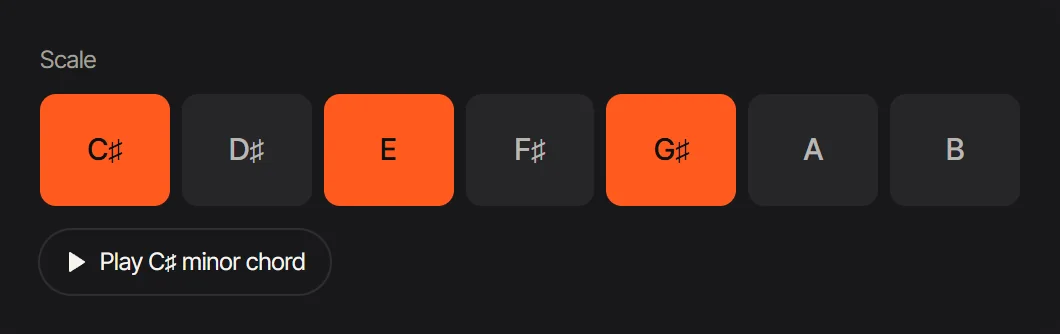 The scale of C♯ minor, with the notes of its home chord lit and a button to play that chord against the song.
What to do with the key
Once you know the key, you can use it.
- Mixing songs: DJs write keys as Camelot codes, 1 to 12 with A for minor and B for major. Codes that are the same, one number apart, or the same number with the other letter blend smoothly. On our Camelot wheel we ordered six songs made on this site with those moves: 10A, 10B, 10B, 11B, 11A, 12A, all between 120 and 134 BPM.
- Singing a cover: count the semitones to a key that fits your voice and move every chord by the same amount. Two semitones down from E major is D major.
- Producing a remix: set your project to the key and every scale tool follows it.
 C♯ minor (12A) on the Camelot wheel, with the three keys that mix well with it: 11A, 1A and 12B.
Which method should you use?
- Learning a song on an instrument: read the chords, then confirm by ear.
- Singing: find the tonic by humming, then pick your own key from it.
- DJ sets and big libraries: a key finder for the whole folder, the Camelot code for planning, and your ears for anything marked unclear.
- Classical or choir music: the key signature and the final bass note.
FAQ
Can a song have more than one key?
Yes. Many pop songs move up a semitone or a whole tone for the last chorus, and longer pieces change key in the middle. A key finder reports the key that dominates the whole file, so to read one section, trim it out first with the audio trimmer and analyse the clip.
What is the most common key?
It depends on the music. In the GiantSteps set of electronic dance tracks, 85% are in minor keys, led by F minor (12%), G minor (10%) and A minor (9%). Across the 837 labelled GTZAN clips, from blues to rock, 57% are minor.
How accurate are key finders?
Ours gives exactly the right key first for about 60% of songs and has it among its two answers for 76% to 80%, on 1,441 songs from two research sets. Treat a single reading as a strong hint, and check unclear ones by ear.
Is the key the same as the first chord?
Often, but not always. Many songs start away from home to build tension. The last chord, or the chord the chorus resolves to, is a safer guide.
What do codes like 8A and 8B mean?
They are Camelot codes. The number is the position on the wheel, A means minor and B major: 8A is A minor and 8B is C major, a relative pair.
Find the key of a song with our key finder
- Open the key finder and drop in a song, several songs or a whole folder. Video files work too. It is free and the files are read in your browser.
- Read the key, its Camelot and Open Key codes, the second candidate and how clear the reading was. The BPM comes from the same listen.
- If the reading is not marked clear, play the chord of each candidate against the song and keep the one that sounds at rest.
- Open the key on the Camelot wheel to see and hear which keys mix with it.
- For a folder, export the list as a CSV for your notes or library.