
What Are Stems in Music? Vocals, Drums, Bass and Other
What are stems in music? The few files a song splits into: vocals, drums, bass and other. What each holds, what we measured and how to get your own.
Audio AI Studio8 min read

On this page
What are stems in music? Stems are the handful of audio files a finished song can be split into, each holding one group of sounds: usually the vocals, the drums, the bass and everything else. Play the stems together and you hear the whole song again; play one alone and you hear only that part. That is what makes them so useful for remixes, DJ sets, practice and karaoke.
To see how well that works in practice, we split five songs made on this site with our stem splitter. In every song, the four stems came back as WAV files of exactly the same length, down to the sample. When we added them back together and compared the sum with the original, the difference was 22 to 25 dB quieter than the song: less than 1% of its energy.
This guide explains what each stem holds, how stems differ from tracks, what we measured and how to get stems of your own.
Stems at a glance
| Stem | What it holds | Typical use |
|---|---|---|
| Vocals | Lead vocal, harmonies, backing vocals, ad libs | Acapellas, remixes, learning the phrasing |
| Drums | Kick, snare, hi hats, cymbals, percussion | Drum practice, DJ intros, sampling a groove |
| Bass | Bass guitar, synth bass, sub bass | Learning a bass line, DJ blends |
| Other | Guitars, keys, synths, strings, pads, horns | Guitar or keys practice, sampling chords |
| Instrumental | Everything except the vocals | Karaoke, covers, background music |
The instrumental is not a fifth sound of its own. It is the drums, bass and other stems played together, and our splitter makes it exactly that way, by adding those three stems.
Stems, tracks and multitracks: what is the difference?
The three words get mixed up, so here is how producers use them:
- A track is one recorded source: the kick drum microphone, one take of the lead vocal, one guitar.
- A multitrack is the whole recording session, often dozens of tracks, each with its own source.
- A stem is a group of related tracks mixed down to one stereo file. All the drum tracks become the drums stem; every vocal track becomes the vocals stem.
So a song with 60 tracks may still have only four stems. A stem keeps the mix decisions made inside its group (levels, effects, panning), which is why it sounds finished on its own and why the stems add up to the song when you play them together at the same level.
Two more words come up all the time. An acapella is the vocals stem alone. An instrumental is the song without its vocals. In film and TV, "stems" usually means dialogue, music and effects; in music, the four part split of vocals, drums, bass and other is the most common one.
The four standard stems, measured
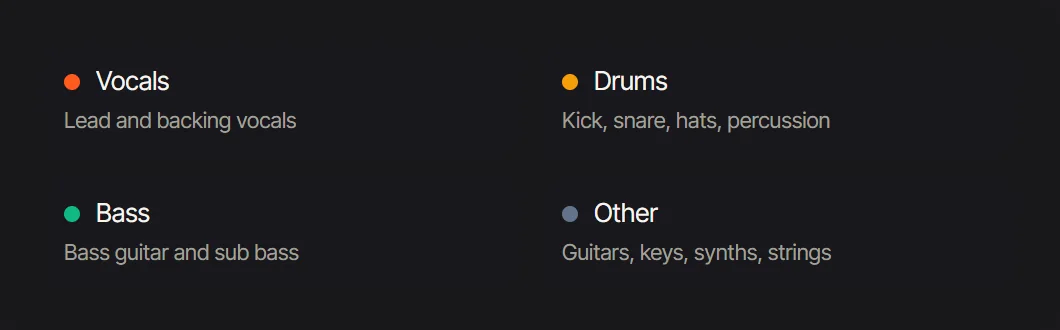 The four stems on our stem splitter page and what each one holds
Each stem has a clear job. Vocals carry the lead voice and everything sung around it. Drums take the kit and most percussion. Bass is the low line under the song, whether it is played on a bass guitar or a synth. Other gathers everything left, so guitars, piano, keys, pads, strings and horns all live there. It is the busiest stem, and the place to start if you want one guitar or piano part.
The five songs we split cover five genres. We measured the loudness of every stem in LUFS, the loudness unit streaming services use (closer to zero is louder):
| Song (genre) | Length | Full song | Vocals | Drums | Bass | Other |
|---|---|---|---|---|---|---|
| Afterglow Signal (house) | 3:08 | -11.1 | -17.1 | -14.1 | -16.5 | -18.7 |
| Corner Store Philosophy (boom bap hip hop) | 3:23 | -11.8 | -18.3 | -15.2 | -17.3 | -18.8 |
| Mirrorball Avenue (funk disco) | 3:16 | -10.6 | -14.7 | -15.7 | -16.9 | -15.4 |
| Northbound Train (indie pop) | 3:05 | -10.1 | -16.7 | -16.7 | -15.6 | -14.2 |
| Sunday Glow (Afrobeats) | 2:55 | -12.2 | -16.1 | -17.0 | -17.2 | -16.9 |
Two things stand out:
- Every stem is quieter than the song, by 3 to 8 LU. A stem holds only part of the sound, so it is quieter on its own; the parts add up again when they play together.
- The loudest stem depends on the genre. Drums lead in the house and hip hop tracks, the vocals in the funk disco and Afrobeats songs, and the other stem, with its guitars and keys, in the indie pop song.
Tip: If you plan to put the stems back together, keep their levels as they arrive. Normalizing each stem on its own changes the balance, and the sum no longer sounds like the song.
How stems are made
There are two ways to get stems, and they suit different situations.
1. Exported from the original session
The producer opens the project in a music editor, solos each group and exports it from the first bar to the end of the song. Exported stems are exact: nothing from one group leaks into another. Labels, remix contests and music libraries often ask for this kind, and only the person who has the session can make them.
2. Separated from the finished song with AI
When all you have is the finished mix, an AI stem splitter estimates which parts of the sound belong to each group and writes every group to its own file. Separated stems are estimates. You may hear faint traces of one stem in another, called bleed, most often in dense mixes with heavy reverb or distorted guitars.
| Question | Exported stems | AI separated stems |
|---|---|---|
| What you need | The original project | Any copy of the finished song |
| Bleed between stems | None | Possible, mostly in dense mixes |
| Who can make them | The producer | Anyone with the file |
| Number of stems | Whatever the producer exports | Usually four, sometimes more |
Our five test songs added back up to within 22.0 to 24.8 dB of the originals. That shows nothing went missing in the split, but it does not measure bleed: a little hi hat can sit in the vocals stem and the sum still matches. Solo each stem and listen before you build on it.
Tip: Split the best copy you have. A WAV or a high bitrate file gives the splitter more detail to work with than a heavily compressed copy of the same song.
What people use stems for
| Job | Keep | Mute or drop |
|---|---|---|
| Remix | Vocals, maybe bass | Drums, other |
| DJ edit or mashup | Vocals over another track | The rest |
| Drum practice | Vocals, bass, other | Drums |
| Bass practice | Everything | Bass |
| Karaoke or a cover | Instrumental | Vocals |
| Music under a voiceover | Instrumental, lower drums | Vocals |
- Remixes: keep the vocal and the bass line, then write new drums and chords around them.
- DJ edits: lay an acapella over another track's drums. Match the tempo and key first; our BPM finder and key finder read both in your browser.
- Practice: mute your own instrument and play the part with the band, or solo it to learn it by ear.
- Karaoke and covers: sing over the instrumental.
- Video and podcasts: use the instrumental as a bed, so the music never fights the words.
Five tips for working with stems
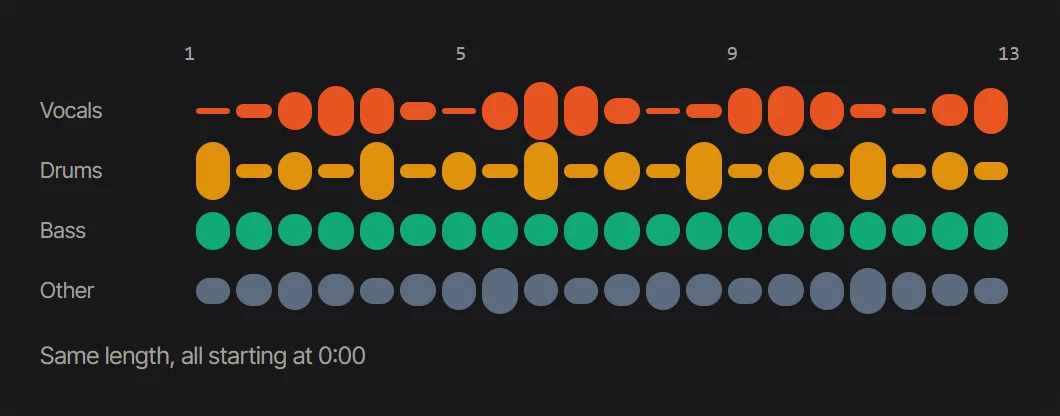 Four stems on one timeline: the same length, all starting at 0:00
- Line them up at zero. Drop every stem onto its own track at the very start of the project. Stems only line up when they have the same length and start at 0:00. Ours do: in our 3:08 house track, each of the four stems has exactly 8,270,955 samples.
- Keep the levels. Leave the stems at the level they arrive at until you have heard them together.
- Keep one sample rate. Our stems come as 16 bit, 44.1 kHz stereo WAV. Set your project to match, so nothing is converted on import.
- Plan for the size. Uncompressed stereo WAV takes about 10 MB per minute: a single stem of our 3:08 track is 31.6 MB, so the four stems of a song take well over 100 MB. Convert the files you only want to share with the WAV to MP3 converter, and keep the WAVs for editing.
- Name them and keep the originals. Name every file after the song and the stem (ours arrive that way), and save your changes as new files, so the clean split is always there to go back to.
FAQ
What is a stem in music?
A stem is one group of a song's sounds mixed into a single audio file, such as all the drums or all the vocals. Several stems played together at the same level make up the full song.
How many stems does a song have?
There is no fixed number. Four is the most common split: vocals, drums, bass and other. Producers deliver more when a project asks for them, for example separate guitars, keys or backing vocals.
Are stems the same as tracks?
No. A track is one recorded source, such as one microphone. A stem is a group of tracks mixed together, so a session with dozens of tracks becomes a handful of stems.
Can you get stems from any song?
You can split any recording you have with an AI stem splitter, though the result is an estimate and dense mixes may show some bleed. Using the stems is a separate question: practicing at home is one thing, but releasing a remix of someone else's song needs permission from whoever owns it.
What format should stems be in?
Uncompressed WAV at the song's sample rate, every file the same length and starting at 0:00, so the stems line up in any music editor. Our stem splitter delivers them that way.
What is the difference between an acapella and an instrumental?
An acapella is the vocals stem alone; an instrumental is everything except the vocals. The vocal remover gives you exactly those two.
How to get stems with our stem splitter
- Open the stem splitter and upload a song: MP3, WAV, M4A, FLAC, OGG or WEBM, up to 15 minutes and 200 MB.
- Sign in and start the split. It costs 8 credits per started minute of the song, shown before you start, and four stems cost the same as two tracks. See pricing for packs and plans.
- Listen in the mixer. The original and the four stems play on one clock: solo the bass, mute the drums, set the levels.
- Download the stems you need as WAV files that line up from the first beat.
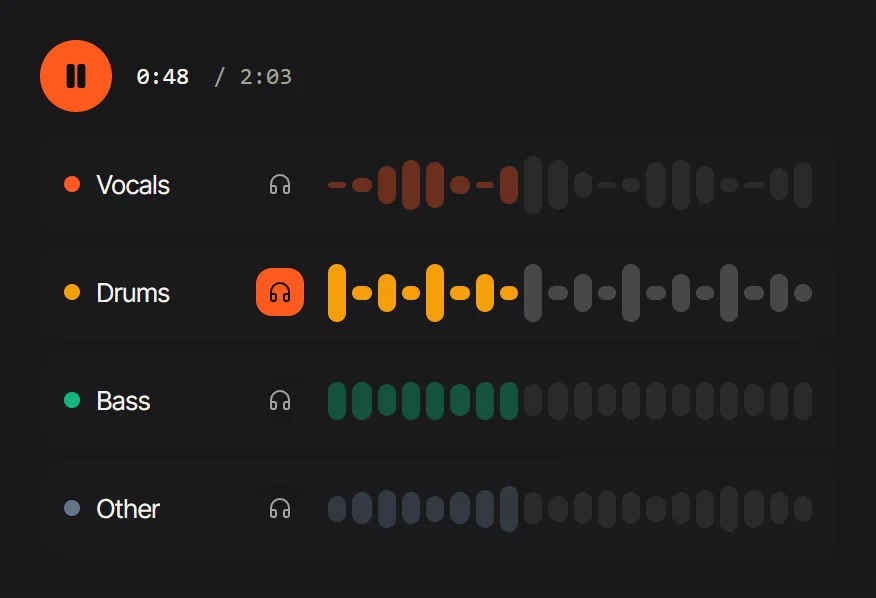 The stem splitter mixer: four stems on one clock, here with the drums soloed
If you only need the vocals and the instrumental, the vocal remover opens on those two tracks, at the same price, and lets you switch between them while the song plays.
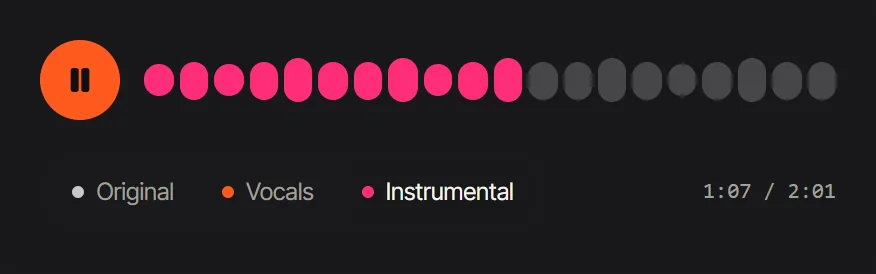 The vocal remover player: switch between the original, the vocals and the instrumental
Your uploads and stems are private: only you can hear them, and they stay in your library for 30 days.
Tools in this article
- Stem SplitterSplit a song into vocals, drums, bass and other, mix them in the browser and download aligned WAV stems.
- BPM FinderDrop songs or videos and get the tempo, a beat grid to check by ear, and the key.
- Key FinderDrop songs and get their key on the Camelot wheel, with chords to check by ear and the BPM.