What Is BPM in Music? How to Find the BPM of a Song
What is BPM in music, how to find the BPM of a song by counting, tapping or with a BPM finder, and the real tempos of house, techno and dance styles.
Audio AI Studio8 min read
On this page
- BPM in one minute
- What BPM tells you, and what it does not
- What BPM is house music? Real tempos by style
- Why 128 BPM?
- Method 1: Count the beats
- Method 2: Tap along
- Method 3: Use a BPM finder
- Half time and double time
- When a BPM reading needs a second listen
- Which method should you use?
- FAQ
- Find the BPM of a song with our tools
What is BPM in music? It is the tempo of a song in beats per minute: how many times a minute you would tap your foot along with it. A song at 60 BPM has one beat every second, a song at 120 BPM has two. BPM tells a DJ which songs can be mixed, a producer how to line up loops, and a dancer or runner whether a track fits their step.
We wanted real numbers rather than rules of thumb, so we looked at two public research sets whose tempos were checked by people: 664 electronic dance tracks and 698 ballroom dance excerpts. The 110 house tracks had a median of 126 BPM, half of them sat between 122 and 128, and 128 was the single most common value. This guide explains what BPM measures, the tempos different styles really use, and three ways to find the BPM of a song.
BPM in one minute
| BPM | One beat lasts | Bar of four beats | Where you hear it |
|---|---|---|---|
| 60 | 1,000 ms | 4.0 s | Slow ballads |
| 100 | 600 ms | 2.4 s | Rumba, samba |
| 122 | 492 ms | 2.0 s | Deep house |
| 128 | 469 ms | 1.9 s | House, tango |
| 140 | 429 ms | 1.7 s | Trance, dubstep |
| 173 | 347 ms | 1.4 s | Drum and bass |
The rule behind the table: one beat lasts 60,000 divided by the BPM, in milliseconds. Producers use the same sum to set delay and reverb times so the echoes land on the beat.
What BPM tells you, and what it does not
BPM measures the pulse, not how busy the music sounds. A ballad can have fast hi hats over a slow beat, and a song can feel slow at a high BPM when its drums only hit every other beat. That second case, called half time, is why two people can tap the same song and get 70 and 140.
BPM also says nothing about how beats are grouped. A waltz counts three beats to a bar, most pop and dance music four. The tempo is still the number of beats per minute either way.
Remember: a BPM is a number of beats, not of bars. A waltz at 87 BPM has 29 bars a minute; a house track at 128 BPM has 32.
What BPM is house music? Real tempos by style
These figures come from the human checked tempo labels in the two research sets. The middle half is the range from the 25th to the 75th percentile, where most tracks of the style sit.
| Style | Tracks | Median BPM | Middle half |
|---|---|---|---|
| Deep house | 24 | 122 | 120 to 123 |
| Tech house | 22 | 126 | 124 to 126 |
| Progressive house | 19 | 128 | 126 to 128 |
| Electro house | 22 | 128 | 126 to 130 |
| All five house labels | 110 | 126 | 122 to 128 |
| Techno | 61 | 126 | 125 to 130 |
| Trance | 74 | 140 | 140 to 140 |
| Dubstep | 76 | 140 | 140 to 140 |
| Drum and bass | 139 | 173 | 170 to 174 |
So what BPM is house music? Usually 120 to 130: three in four of the 110 house tracks fell in that band, and half of them between 122 and 128. Deep house runs a little slower, electro and progressive house a little faster.
Dance styles in the ballroom set have their own tempos, set by the steps:
| Dance | Excerpts | Median BPM | Middle half |
|---|---|---|---|
| Waltz | 110 | 87 | 84 to 87 |
| Rumba | 98 | 100 | 96 to 104 |
| Samba | 86 | 102 | 100 to 102 |
| Cha cha | 111 | 124 | 124 to 124 |
| Tango | 86 | 128 | 128 to 128 |
| Jive | 60 | 172 | 168 to 176 |
| Viennese waltz | 65 | 180 | 177 to 180 |
| Quickstep | 82 | 204 | 200 to 204 |
Why 128 BPM?
In the dance music set, 128 was the most common tempo among house tracks: 23 of the 110, about 21%. It was not the most common tempo overall, though. Trance and dubstep cluster at 140 and drum and bass near 174, so 128 is a house habit rather than a rule of dance music.
Two practical things make 128 BPM convenient:
- It sits in the middle of the house range. A song at 124 only needs to speed up about 3% to meet it, and one at 130 to slow down about 1.5%, so most house tracks can be mixed into a 128 BPM set with a small change.
- The arithmetic is tidy. At 128 BPM a beat lasts 468.75 ms, and eight bars of four beats last exactly 15 seconds, so loops and phrases line up with round clock times.
Most tango excerpts in the ballroom set sit at 128 BPM as well.
Method 1: Count the beats
You need a clock and some patience.
- Play the song and find the beat: the kick drum or the snare usually marks it.
- Count the beats for 15 seconds.
- Multiply by 4 to get beats per minute.
Counting is less precise than it sounds. One missed or extra beat in 15 seconds moves the result by 4 BPM; count for 30 seconds and multiply by 2 and the error halves to 2 BPM; count for a full minute and it drops to 1.
Method 2: Tap along
Tapping is faster than counting and more precise, because the tool measures the time between taps instead of counting whole beats.
- Open a tap tempo tool such as our tap BPM page.
- Play the song and tap any key, click or touch the pad on every beat.
- Keep going until the reading is marked steady. Ours uses your last sixteen taps, sets aside a tap that comes far too late, and calls a reading steady once eight taps fall within 4% of each other.
- Check the number against the metronome. If the clicks drift, nudge the tempo by one.
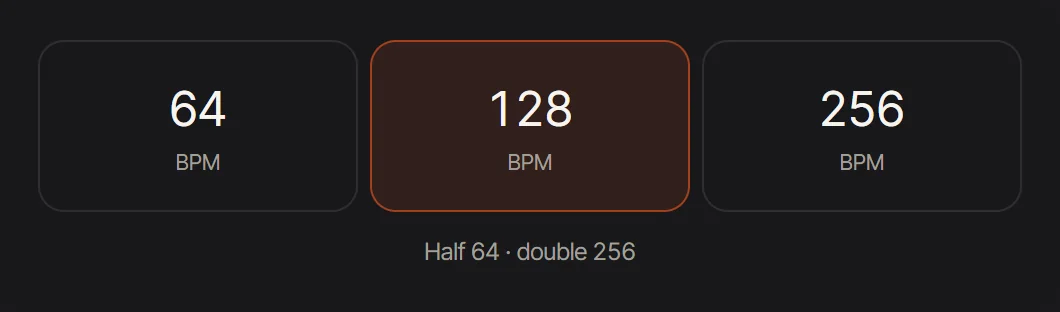 A tapped tempo of 128 BPM, with its half (64) and double (256) shown beside it.
Method 3: Use a BPM finder
A BPM finder listens to the file for you. Ours listens for onsets, the moments the sound changes, works out the gap at which they repeat most strongly, and prefers the tempos people usually count. Then it marks every beat it heard and fits a line through them, which is why it can say 127.9 instead of rounding.
Three readings from the samples on our BPM finder page:
- A house loop we made at exactly 128 BPM read 128.0.
- A slow lo fi beat read 89.0, with 44.5 and 178.0 listed beside it as fair readings of the same pulse.
- The sound of a music video, read straight from the MP4 file, came out at 138.8.
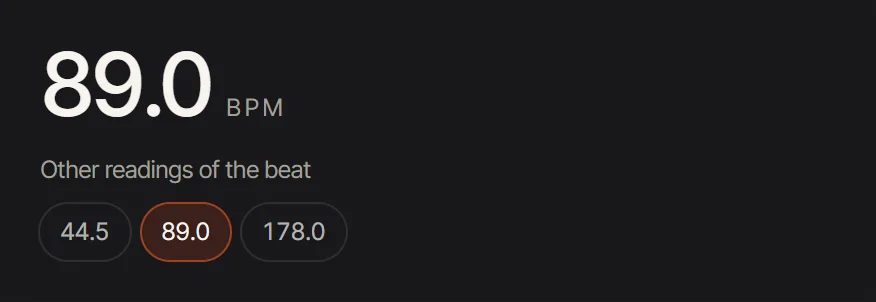 A reading of 89.0 BPM, with the other readings of the same beat (44.5 and 178.0) beside it.
On the two research sets, the true tempo was the first reading, within 4%, for 77.9% of the 664 dance tracks and 71.2% of the 698 ballroom excerpts. Counting the other readings the finder lists beside it, the true tempo was there for 97.1% and 92.6%.
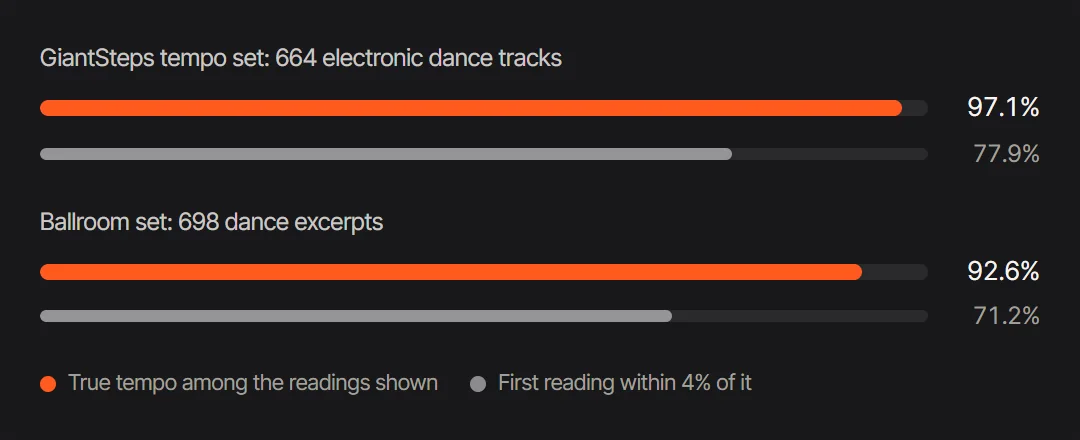 Measured on two public research sets: how often the true tempo is among the readings shown, and how often the first reading is within 4% of it.
Half time and double time
Most disagreements about a song's BPM are not errors but counting choices. Of the 22.1% of dance tracks where our first reading missed, 18.9 points were the right pulse counted at another level: almost always half or double the tempo, and half three times as often as double.
People split the same way. In the human labels of the dance music set, 16 of the 139 drum and bass tracks are labelled between 80 and 88 BPM, about half the usual 174, and four dubstep tracks are labelled 70 instead of 140. Neither label is wrong. Pick the number that matches how the music is danced or written: in most pop and rock the snare lands on beats two and four, which gives the usual count.
Tip: if a reading feels twice too fast, tap only on the snare. If it feels twice too slow, tap on every hi hat.
When a BPM reading needs a second listen
Some music has no steady pulse to find. Ambient pieces without drums, live recordings that speed up and classical music with a free tempo give weak or changing beats. Our finder says how clear the beat was: on the dance music set, readings marked clear were right first time for 85.9% of tracks, those marked "check by ear" for 52.5%. A recording with no beat at all, such as speech, gets no tempo instead of a guess.
To check a reading, play the song with clicks on its beats. If the clicks stay on the drums for the whole song, the tempo is right. If they drift slowly, the song changes tempo; if they fall between the beats, try another reading.
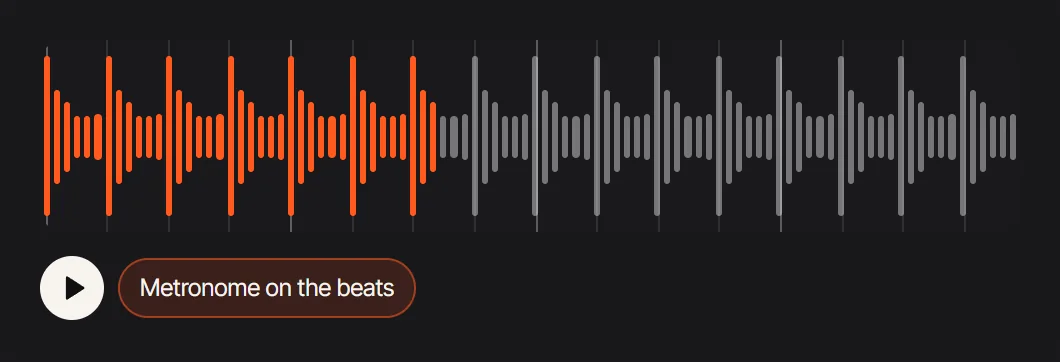 Beat lines on a song's waveform, with a switch that plays a click on every beat.
Which method should you use?
- One song, nothing installed, any device: tap it.
- A file you have, or a whole folder: a BPM finder gives the tempo to a tenth and checks it with a beat grid.
- Music playing in a shop or on the radio: tap along, or count for 30 seconds.
- A song that changes tempo: cut out the part you need and read that.
FAQ
What does 128 BPM mean?
128 beats every minute: a beat every 469 milliseconds, a little over two beats a second. Eight bars of four beats take exactly 15 seconds.
What BPM is house music?
Mostly 120 to 130 BPM. In 110 house tracks from a research set, the median was 126 BPM and half sat between 122 and 128.
Is there a normal BPM for a song?
No single one. It depends on the style: in the sets we measured, waltzes sat at 84 to 87 BPM, house at 122 to 128 and quickstep at 200 to 204.
Does a higher BPM always sound faster?
Not always. A dubstep track at 140 BPM is often felt at 70, because its snare lands only once a bar, on the third beat. The BPM is the same; the feel is half time.
Can a song have more than one BPM?
Yes. Live recordings drift, and some songs change tempo between sections. To measure one section, trim it out with the audio trimmer and read the clip.
How accurate is tapping?
Good enough for most uses if you keep going. Counting for 15 seconds can be off by 4 BPM per missed beat; a tap tool measures each gap, and ours marks the reading steady only once eight taps agree within 4%.
Find the BPM of a song with our tools
- Open the BPM finder and drop in a song, several songs, a whole folder or a video file. It is free and the files are read in your browser.
- Read the tempo to a tenth of a BPM, with half, double and any other fair reading beside it, and how clear the beat was. The key comes from the same listen.
- Turn on the clicks and play the song: the beat grid on the waveform shows whether the reading sits on the drums. Switch to another reading if it does not.
- For a folder, sort the list by BPM and export it as a CSV.
- For music you can only hear, open tap BPM and tap along until the reading is steady.